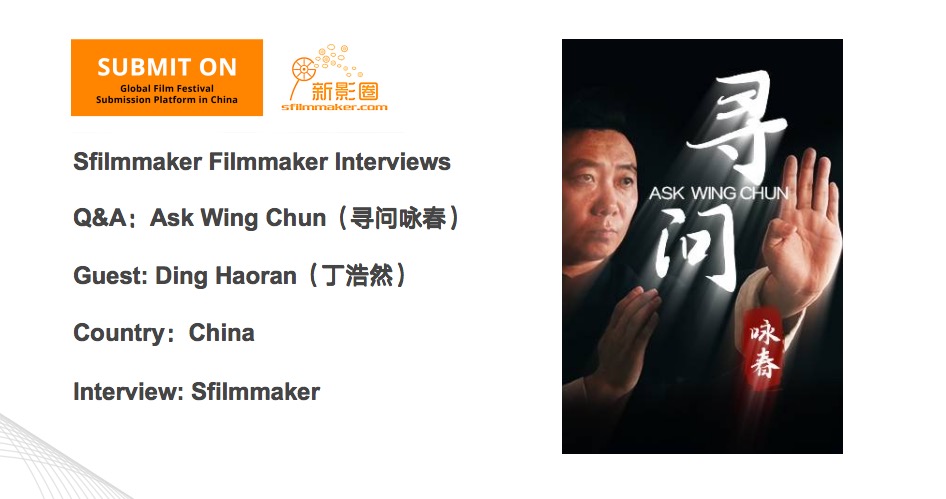
Profile:
Ding Haoran: Born on 2001.02.13, he is currently studying at Hebei University-Central Lancashire College of Media and Creativity, Film. Major Courses: Audio Production, Video Production, Documentary Creation, Narrative Film Creation, Film and Television Screenwriting, Film and Television Writing, Computer Cartography, etc., he has directed many films such as: Life Should Be Like This, Quietly Love You, Healthy Superman, etc. and has won a large number of awards in China. And he has composed music: Light up youth, join hands with the Winter Olympics, run to the future Has been reported by many well-known media in China.
Question 1:
Ding Haoran, the director of ‘Ask Wing Chun’, has made films about a wide variety of subjects; Life Should Be Like This, Quietly Love You & Healthy Superman to name three. What made you want to make a film about Wing Chun Kung-Fu?
Ans:
Because Wing Chun is a representative martial art among traditional Chinese martial arts, it contains an abundance of Chinese wisdom and rich philosophy. At the same time, the release of the movie "Ip Man" has also made many Chinese and foreign friends have a strong interest in Wing Chun, so I hope that through this film, everyone can understand Wing Chun culture, inherit and develop Wing Chun culture, and hope that friends around the world can understand Wing Chun culture and tell the story of China well.
Question 2:
The film deals specifically with the controversy regarding Chinese Kung-Fu and whether it is out-dated and no longer effective compared to modern Mixed Martial Arts. Is Kung-Fu dying out in China?
Ans:
First of all, Wing Chun, as the representative of Chinese kung fu, has undergone the baptism of historical years and has been passed down to the present day. There is no doubt about its actual combat. If it does not have actual combat, then it will be erased by history in the context of the ancient Chinese era, and now its inheritance method has undergone some changes, but this does not deny its actual combat. The reason why Chinese kung fu is now somewhat inferior compared with the current comprehensive combat is because of its training methods and the constraints of related rules are somewhat different, but this does not negate its timeliness. Secondly, Wing Chun culture is one of the representatives of traditional Chinese kung fu. It contains a lot of Chinese culture and Chinese philosophy and now, the country also attaches great importance to the inheritance of related cultures and we will also work hard to record these outstanding cultures of Baohua, so I don't think it will die out in China.
Question 3:
The film often mentions Chinese ‘intangible cultural heritage’. This is a phrase which comes from the UNESCO but most foreign audiences will not be familiar with it. What does it mean and why is it important?
Ans:
According to the relevant definition, "intangible cultural heritage" refers to the various traditional cultural expressions passed down from generation to generation by people of all ethnic groups and regarded as an integral part of their cultural heritage, as well as objects and places related to traditional cultural expressions. It is an important symbol of the historical and cultural achievements of a country and a nation, and an important part of excellent traditional culture. It is important because it is the crystallization of the wisdom of a nation and a country, it is the root and soul of a nation, and it is the nation's belief in the country.
Question 4:
Should China export it’s culture overseas in the same way countries like the USA and India do through their media industries? How do you think China can better show it’s unique culture to the world in the future?
Ans:
I think China should go out of its own way and show Chinese culture to friends around the world through its own way, so that more people can understand China and understand China, and I also hope that through our own way, friends of all ethnic groups across the globe can communicate with each other, understand each other and make progress together. In the future, I hope that we can express our unique culture through the form of these films, show it to the world, and tell the Chinese story well.
Question 5:
Are you working on any projects right now and what can we expect to see from you in the future?
Ans:
I am currently preparing a martial arts film, which is a story that happened in the context of ancient China and it contains some Chinese ideas and views on some issues of concern to the world, and I also hope that we can shoot more problems facing mankind in the future, and I hope that we can pay attention to it together and make some efforts and responsibilities towards the development of the world.
What future projects do you have coming up? What are you working on right now?
Answer:
I'm working on another musical movie soon, and a third-draft script for a theatrical movie as well. The progress of some projects has been very slow due to the epidemic.
But instead, there is more time to think, maybe life needs a kind of stop, calm down and settle down, and there will be better inspiration for the future.
Interviewed by: David James Bell
Edited by: Sfilmmaker
Comments
Post a Comment